Venture studio for Optimism projects, offered by Pollen Labs - General communication thread

Greeting builders & citizens,

We are Pollen Labs and were recently awarded a grant in season 6. We are posting this update as a general communication thread and will start inviting project leads to collaborate with us. We leverage our skills to accelerate and incubate your innovations.

A little background: We have previously worked within the Privacy and Scaling Exploration team at the Ethereum Foundation. In the early days, we have been incubating projects that use PSE’s primitive to design and build applications; the most famous ones are Unirep.social and Channel4, along with a handful of product discoveries. While this mission was exciting, we realized that we could leverage our skills with other innovators; that is when we started to collaborate with team Next Billion; we have collaborated with VoiceDeck and are currently developing the Enaleia hub, which contributes to the marine environment in the Mediterranean Sea.

Since we were awarded in season 6, we have been scanning through all the past grantee projects and what builders are doing in the community. Today, we would like to invite you to this adventure. Please reach out if you are building on optimism and need a hand!

What we can help with are;

  • Business design & strategy
  • Product design
  • Application development
  • Go-to-market strategy
  • Brand design
  • Marketing & Community growth

Sometimes, it’s hard to know if you need help like the one mentioned above. We encourage you to chat with us so we can guide you!

Skip the form, just shoot us a message at:

Discord #builder-lobby

X

We are thrilled about this mission and will share updates regularly as we progress.

7 Likes

To maximize our efforts to generate the most impact for the ecosystem and, most importantly, in the social impact setting, below are the questions we will ask to evaluate the potential projects for our collaboration; remember, this evaluation is to evaluate the impact we can generate with the projects, not on the project’s potential itself.

First, let’s revisit the statement from the mission request:

“This mission aims to provide new business support for projects within the Optimism ecosystem, including projects with approved grants in previous governance seasons. This program will focus on delivering support for major back-office and dev concerns faced by new startups, things such as legal counseling, dev agency work, business formation, tax prep, and so on.”

Second, we want to mention the team’s desires. As mentioned in the previous post, we have collaborated with team Next Billion since Q3 203; we are particularly interested in helping projects that contribute significantly to social and environmental contexts. Therefore, we will be weighing the factors related to this desire heavily.

We will meet early & mid-stage projects that are interested in collaborating with us. Here are the question and its weight for our evaluation.


Alignment with OP Ecosystem Goals

Weight: 30%, this criterion evaluates how well the project supports and strengthens the Optimism ecosystem.

  • How well does the project align with the ecosystem’s mission and objectives?
  • Does it address a critical gap or pain point within the ecosystem?
  • Will the project attract more users, developers, or partners to the ecosystem?
  • Does the project encourage the adoption of the OP’s ecosystem and stack?
  • Will the project strengthen collaboration and interdependence within the ecosystem?

Social Impact

Weight: 25%, this criterion assesses the project’s ability to create meaningful social benefits, with an emphasis on equity, accessibility, and public goods.

  • Does the project improve access for underserved or marginalized communities?
  • Does the project offer open-source tools, knowledge, or infrastructure for collective benefit?
  • Does it empower communities economically (e.g., enabling wealth creation)or socially?
  • Does it improve ecosystem literacy for technical and non-technical audiences?

Market Potential

Weight: 20%, this criterion evaluates the project’s ability to address a significant and growing market.

  • Is the target market large and growing?
  • Does the project have a unique selling point (USP) or strong differentiation?
  • Can the project scale efficiently across geographies or customer segments?

Feasibility and Progress

Weight: 15%, this criterion examines the practicality of the project’s plans and its current stage of development.

  • For mid-stage projects, is there a functional product or prototype? For early-stage, is the roadmap realistic?
  • Are the project’s financial plans realistic and sustainable?
  • Are key risks identified, and does the team have a plan to mitigate them?

Team Setting and Capability

Weight:10%, this criterion measures the competency and structure of the project’s team.

  • Does the team have relevant experience and expertise in the target industry?
  • Has the team demonstrated the ability to deliver results and adapt to challenges?
  • How many ongoing members are working on the project?

We will be having calls with the project builders and internally evaluating based on the matrix above. We will also share this document with the builders as their first touch point.

2 Likes

Over the past three months, Polle Labs has reviewed grantee projects from Optimism, met with project builders to understand their goals, and analyzed opportunities for collaboration to maximize the impact of this mission request.

Here’s what we accomplished during this milestone:

First Stage of Filtering:
Our approach at this stage was straightforward. We assessed whether each project was still ongoing, tried the proof of concept if any, and determined if it aligned with Pollen Labs’ interests. This process narrowed our list down to 22 projects.

Second Stage of Filtering:
In this stage, we evaluated whether the projects had not yet achieved high scale and if they had received significant venture funding. We also aimed to eliminate any bias by filtering out projects with which any member of Pollen Labs had been involved. This led us to filter down to 6 projects.

Additionally, we received two inbound requests for our support.

We identified eight projects in total. However, we could only speak with five project builders; some did not respond to our initial outreach.

During these three months, we connected with each project builder. Some engaged with us through two calls, while others preferred asynchronous communication. We also created a matrix to evaluate our capabilities & potential impact for these projects. Ultimately, we have decided to support the following two projects:

Tier 1: MesoReef

We are excited about MesoReef’s mission and the potential impact it can have. Given the multifaceted challenges associated with this project, we believe our expertise will be most beneficial. We will assist with product strategy, planning, design, and development, from concept to MVP.

Tier 2: Flow State

Initially, we reached out to the team as the GeoWeb network and learned about the other project, Flow State, through our initial call. After analyzing the ongoing Flow State project, we are eager to contribute by addressing its current gaps. We will focus on product design and basic frontend development while working closely with the core Flow State team.

Allocation breakdown per project in each milestone

Milestone 2

Project Activities Allocation %
MesoReef Ideation, strategy planning, market research. MVP scoping & design. 80%
Flow state Design audit, user research. Product strategy ideation. 20%

Milestone 3

Project Activities Allocation %
MesoReef MVP design & development. Website revamp, coding with AI. 80%
Flow state Experience design, UI polish, Frontend coding with AI. 20%

Milestone 4: Open.

Objective: To develop and engage target users in a healthy feedback loop.

To inspire developers from other communities and interests to participate in future development.

We will evaluate how to approach this milestone when we reach milestone 3.

1 Like

Update: Milestone 2 - Research and Understanding Phase

In this phase, we focused on deepening our understanding of the MesoReef DAO’s vision and the landscape of supporting open-source builders from Flow State, as well as where our contribution could have the most impact. Guided by a design-led and collaborative mindset, we approached this work with openness and a commitment to learning.

For MesoReef DAO

We took a step back by learning about the tools available to help scientists in this field. We have stumbled on amazing projects like CoralNet and toolings made by NOAA, to projects like iNaturalist and Zooniverse. We were inspired by these projects and ideated on how we could leverage the characteristics of blockchain to generate meaningful impact.

What we did:

  • Engaged with the DAO member to explore ambitions for Web3 in coral conservation.
  • Reviewed MesoReef’s current activities and how they align with its goals.
  • Researched the global coral conservation landscape and key actors.
  • Examined scientific reports highlighting critical challenges in the Mesoamerican Reef.
  • Investigated how data is used in conservation, including citizen science and open platforms.
  • Considered how Web3 could support openness, transparency, and public participation.

Key takeaways:

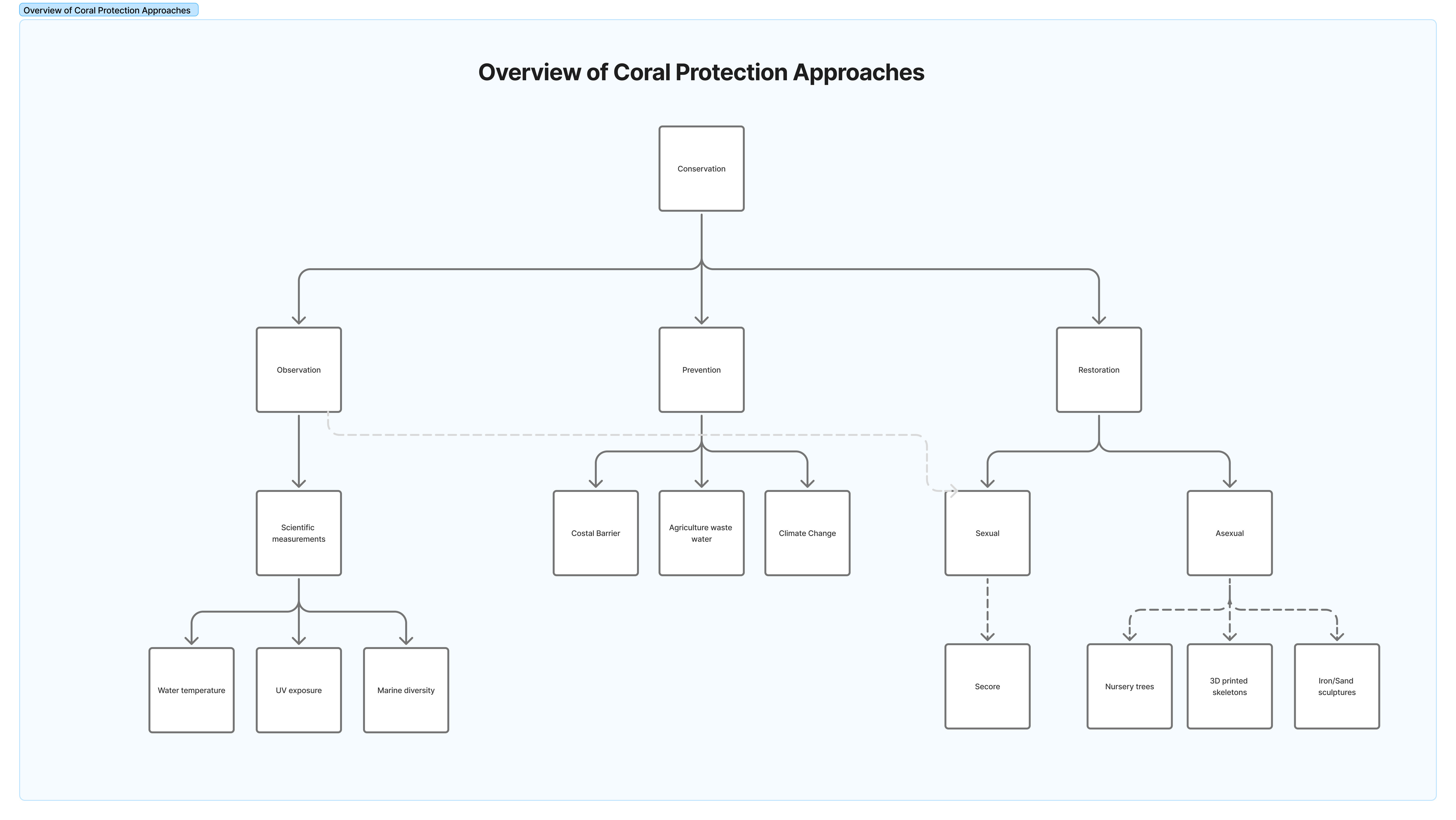
We identified multiple, complementary paths to advancing reef conservation, ranging from ongoing restoration efforts to enhanced data sharing and increased public engagement. This milestone helped clarify how blockchain tools can add unique value by fostering participation and connecting diverse stakeholders. We also saw the importance of refining objectives to ensure any proposed solutions address the most urgent ecological and community needs.

Resources:

Coral conservation landscape

Chart of overview coral protection approaches

For Flow State

Flow State has been solving the problems that every builder in the ecosystem is facing, including ourselves. We planned to review the current communication strategy and design to identify areas where we can provide the most effective support. At the same time, we have been monitoring the TG and Discord community group to observe what excites the members the most.

Collaborated with the project owner and ideated on the brand personality. The team proposed a strong metaphor of using Breaver as the mascot for the brand. We had a lot of fun drafting design in this milestone and revamping the landing page for the team.

What we did:

  • Design audit on current site and app
  • Brand research
  • Content drafting
  • Landing page design

Key takeaways:

While gathering feedback from various community channels, we realized there is no simple solution to triage feedback across channels, unless you build an automation for it. We have learn so many struggles in the ecosystem about self-sustainability. Collaborating with Flow State really made us excited about the possibility that teams are building for all the builders and the ecosystem.

Sneak peek:

The new branding would go live, and the landing page would serve as the initial introduction. Flow State team would develop the new design once they are free up on their priorities. We will continue to assist with the implementation.

Milestone 3 – Project Development: In Progress

Building on the insights from milestone 2, our collaboration with MesoReef DAO moved from research into action. After meeting with the DAO’s founder, our team began designing MesoReef’s first application. What started as a proof of concept soon evolved into a much larger, more complex initiative than our initial scope allowed. To stay aligned with our resources and the mission intent, we chose to refocus our efforts on delivering tangible value.

We revisited the original idea proposed by the founder to develop a web app for reef regeneration attestation. At the time, the idea was a high-level concept showcasing a basic EAS. We set out to refine and expand this early concept, not to over-engineer it, but to create a usable, lightweight application that could evolve and grow over time.

This required our team to dive deep into the world of marine biology and coral restoration practices to ensure scientific and practical relevance. Our research informed the development of the tool that will serve NGO, academic and citizen scientists, with a broader mission in mind: to help nature through verifiable, transparent records of restoration activity.

This direction strongly connects with lessons learned from our earlier work: Enaleia Hub, a non-profit that faced similar challenges in demonstrating impact without overextending its operational capacity. Restoration initiatives like coral planting require months, often years, before measurable results can be shared. Our challenge, then, became: how might we design a platform that benefits MesoReef DAO, its peers, its donors, and the public while ensuring transparency and permanence?

Existing centralized systems already provide valuable visibility but remain vulnerable to funding shifts and political cycles. DeSci, by contrast, would offer a permissionless and immutable infrastructure for maintaining public scientific records.

What we did:

Throughout the design & development phase, we tested multiple Web3 tools to reduce user friction and improve reliability:

  • Tooling experiments: We conducted proof-of-concept trials using various wallet providers, testing their compatibility with EAS and cross-platforms.

  • UX and architecture iteration: We evaluated native vs. web deployment and discovered that many third-party integrations were either incompatible with react-native, or simply not sustainable financially for open-source, mission-driven use.

  • Design evolution: We briefly created and later discontinued the wireframe for the MesoReef DAO website after the project scope changed, as MesoReef independently decided to move forward with another partner. That work was redirected into the design logic for refinement of the reef regeneration attestation app.

Key takeaways:

  • Building a public-good project in a Web3 way remains challenging due to a lack of incentives and limited accessibility tools.

  • Most existing technologies are built with financial use cases in mind rather than ecological or research-oriented applications.

  • Pricing models for blockchain services often do not support small non-profits or open research initiatives, quickly becoming financially unsustainable as usage grows.

We advocate for the introduction of public-good pricing tiers and ecosystem support structures for builders in the DeSci and sustainability spaces.

What’s Next:

We are currently designing & developing the coral restoration attestation platform, which allows marine organizations to record and verify restoration events, particularly outplanting activities onchain. The platform is designed to scale toward a broader ecological verification framework while remaining lightweight and accessible.

This milestone update reflects progress, adaptability, and focus rather than completion. We aim to launch the first public version of the app in the coming weeks.

References:


FlowState Update

In parallel, our team completed FlowState’s branding and landing page design, now viewable here:


This update represents the iterative nature of Pollen Labs’ work, embracing pivots as opportunities for refinement, maintaining alignment with our mission, and continuing to bridge design-driven innovation with the Ethereum ecosystem.
Milestone 3 - Project development: Completion

Following our last update on Milestone 3, the team has conducted thorough research and gained a deeper understanding of coral restoration activities. Our goal is to create a meaningful application that will help the MesoReef DAO succeed and engage its peers. This update marks the completion of Milestone 3 and highlights Pollen Labs’ activities and insights gained during this process.

Introducing you: Reef.Regen

A lightweight web application that empowers organizations, citizen scientists, and communities to create verifiable, blockchain-based records of their coral restoration activities. The platform provides impact makers with an accessible, permissionless method to document and showcase their conservation work.

Motivation

Despite numerous coral restoration initiatives undertaken by organizations and communities worldwide, there is currently no easy, open platform enabling the public to access information about restoration efforts by time and location. While attempts have been made by entities such as NOAA and projects like the Coral of the World Map, these platforms often depend on government funding and frequently contain outdated information.

Reef.Regen addresses this persistent challenge by providing organizations and communities with an intuitive way to communicate and verify their impact. In alignment with MesoReef’s mission, we are connecting coral reef restoration with Ethereum blockchain technology, creating a bridge between traditional conservation organizations and the Ethereum ecosystem.

Target user group

  • Coral restoration organizations and community projects that want to showcase and generate proof of their activities.
  • Citizen scientists who want to create verifiable records of their contributions.
  • Funders and DAOs seeking transparent and credible data for impact-based financing.

Predictable outcome:

Reef.Regen serves as an entry point for traditional coral restoration organizations to experience a decentralized, transparent way of showcasing their work. By making blockchain verification simple and accessible, it empowers projects to build credibility, attract new funding opportunities, and connect with the growing ReFi and DeSci ecosystems.

The platform bridges conservation and Web3, helping impact makers move from isolated reporting toward open, verifiable, and fundable restoration records.


Reef.Regen is currently deployed on OP sepolia for the time being, target to deploy on mainnet at end of Nov. We welcome you to test out and find bugs for us at: https://reefregen.org/

Demo:

For Flow State

We are also happy to see that flowstate.network has a new brand makeover. We hope this rebranding and landing page design helps the team push forward their mission.

What’s next:

  • Finalized first wave feedback and bug fixes
  • Deploy on mainnet at end of Nov ~ early of Dec
  • Community engagement via marketing campaign, Coral restoration group focused
  • Revisit Flow State & understand the outcome of the new landing page